
- by Teacher Dave
Why Kids Learn Languages Faster Than Adults (and How to Help Them)
Reading Time: 3 minutesLanguage learning often feels like a steep uphill climb for adults, while children seem to pick up new words and accents effortlessly. This isn’t just perception—there are real cognitive, social, and environmental reasons why kids tend to learn languages faster.
Understanding these differences can help parents, educators, and even adult learners create better strategies for success.
Table of Contents
The Science Behind Faster Learning in Children
Children’s brains are uniquely wired for language acquisition. During early development, the brain is highly plastic, meaning it can easily form new neural connections. This flexibility allows children to absorb sounds, grammar patterns, and vocabulary naturally, often without formal instruction.
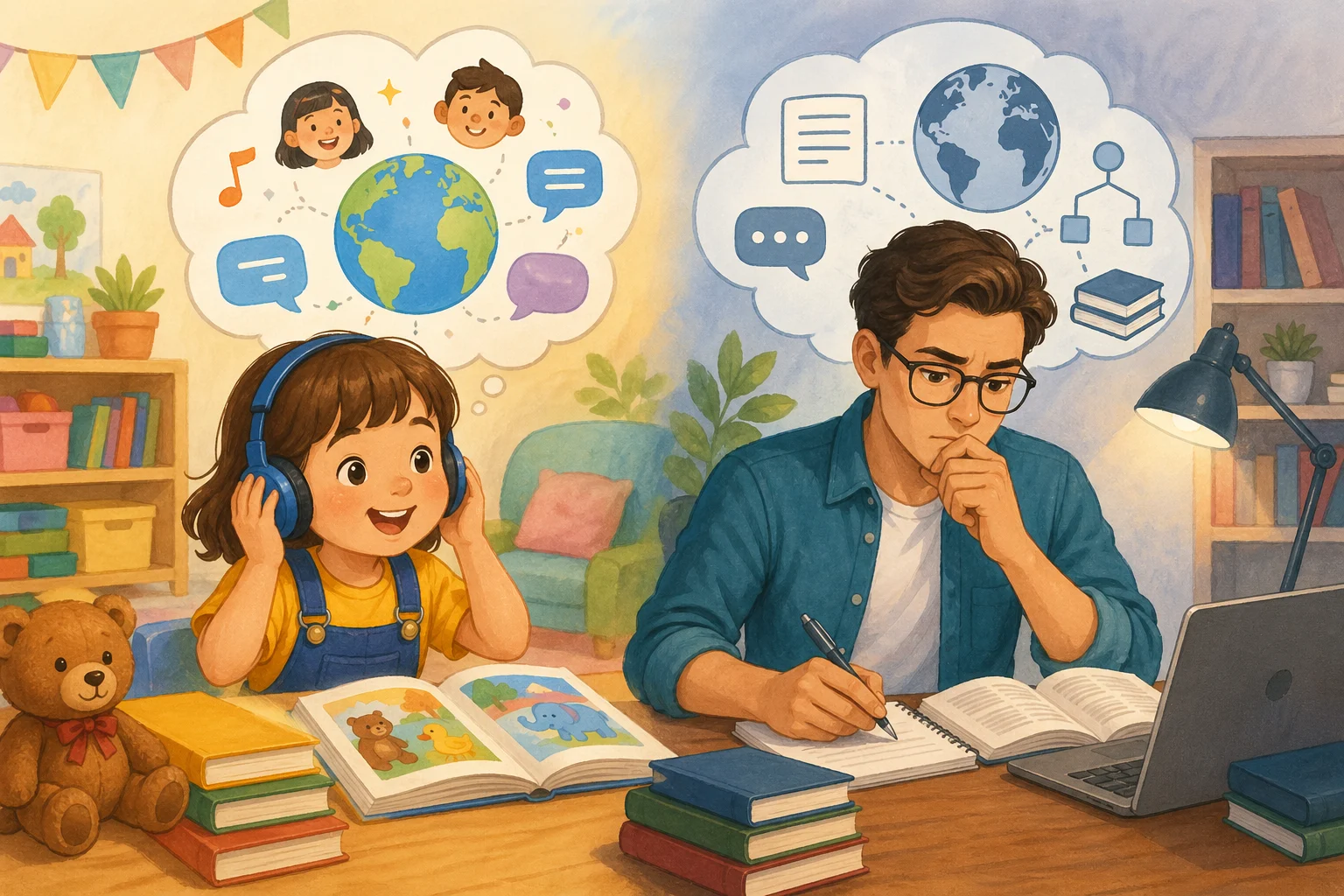
Young learners also rely heavily on implicit learning. Instead of memorizing rules, they intuitively grasp how language works by listening and interacting. Adults, on the other hand, tend to depend on explicit learning—studying grammar rules and translating—which can slow down fluency.
Another key factor is pronunciation. Children are better at mimicking new sounds because their brains are still fine-tuning speech patterns. This is why kids can often achieve near-native accents, while adults may retain traces of their original language.
The Role of Environment and Exposure
Kids are usually immersed in language-rich environments. Whether at home, school, or through media, they’re constantly surrounded by opportunities to hear and use language in meaningful ways. This consistent exposure reinforces learning without it feeling like a chore.
In contrast, adults often learn languages in structured settings like classrooms or apps, with limited real-world practice. Without immersion, it becomes harder to internalize the language.
Social factors also play a role. Children are less self-conscious and more willing to make mistakes, which accelerates learning. Adults may hesitate out of fear of embarrassment, reducing valuable practice time.
Motivation and Emotional Factors
Children are naturally curious and motivated by play. They don’t approach language learning as a task—they see it as part of exploration. Songs, games, and storytelling make the process enjoyable and engaging.
Adults often have clear goals—career advancement, travel, or personal growth—but their learning can feel pressured. Stress and perfectionism can interfere with progress, making it harder to stay consistent.
How to Help Kids Learn Languages Even Faster
Even though children have natural advantages, the right support can significantly enhance their learning.
Start by creating a rich language environment. Surround kids with books, music, and conversations in the target language. The more exposure they get, the better.
Encourage interaction rather than passive learning. Conversations, role-playing, and storytelling help children actively use the language, reinforcing what they hear.
Make learning fun. Games, cartoons, and songs can turn language acquisition into an enjoyable experience rather than a structured task.
Consistency is crucial. Short, daily exposure is far more effective than occasional long sessions. Regular practice helps build strong neural connections.
Finally, be supportive and patient. Celebrate progress, not perfection. Confidence plays a huge role in language development, and a positive environment encourages kids to keep trying.
Can Adults Learn Like Kids?
While adults may not match children’s natural language absorption, they have their own strengths. Better focus, discipline, and access to learning resources can lead to strong results when used effectively.
Adults can borrow strategies from children’s learning styles—immersing themselves, practicing regularly, and embracing mistakes. By shifting away from perfectionism and toward consistent exposure, adults can make significant progress.
Conclusion
Children learn languages faster than adults due to brain plasticity, natural immersion, and a fearless approach to communication. However, this advantage doesn’t mean adults are at a disadvantage—it simply highlights different learning paths. By creating engaging, consistent, and supportive environments, we can help children maximize their natural abilities while also applying those same principles to improve language learning at any age.

Teacher Dave
Teacher Dave is an enthusiastic and dedicated educator behind OnlineDutch4Kids, a platform designed to help expat children aged 5 to 12 learn Dutch in a fun and accessible way. With a strong passion for language learning and child development, he focuses on creating engaging, interactive lessons that make Dutch approachable for young learners who may be new to the language. Through Free Dutch Online, Teacher Dave combines storytelling, games, songs, and visual materials to keep children motivated and curious. His teaching style is patient, encouraging, and tailored to the needs of international families, helping kids build confidence in speaking, listening, reading, and writing Dutch at their own pace. By blending education with creativity, Teacher Dave has built a supportive online learning environment where children from around the world can connect with the Dutch language in an enjoyable and meaningful way.